
How can you help our CDG community? It is easy! Share among your social media and other channels the information we make available within this section and website. This raises awareness, accelerates diagnosis, and secures better care and management for our CDG children and adults!
Guidelines for best practices in clinical care are becoming more and more useful tools for both patients and health care professionals in a number of disease areas. Clinical practice guidelines (CPGs) for rare diseases (RDs) are scarce, may be difficult to identify through Internet searches, and may vary in quality depending on the source and methodology used in order to contribute to the improvement of the diagnosis, treatment, and care of patients.
Paragraph without Menu
This is the case in CDG, where scarcity of expertise is a well-known and far too common cause of late or wrong diagnosis and care. Orphanet (www.orpha.net) is a well-known resource for rare diseases and expertise that makes sure everyone has the same access to information.It has been developed in Europe since 1997 and provides clinical practice guidelines (CPGs). Orphanet has set up a process for choosing CPGs, judging their quality, and sharing them. The goal is to make it easy to find relevant, accurate, and specific advice for managing RDs. For clinical guidelines to be useful and reliable, they must follow rules about how they are made and changed, such as using the best available evidence as a starting point.
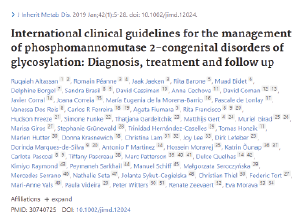
Guidelines are tools for practitioners to make informed decisions. And it is recommended that families be aware of the existence of CDG guidelines. We encourage you to share them with your doctors, teachers, and other people who may benefit of this materials:
Vanessa Ferreira (CDG & Allies FCT, NOVA University, World CDG Organization and Portuguese Association for CDG).
Revisor
Ana Verde (collaborator at CDG & Allies FCT, NOVA University).
Content manager
Marisa Godinho (collaborator at CDG & Allies FCT, NOVA University).
Disclaimer
The Site cannot and does not contain medical or health advice. The information is provided for general informational and educational purposes only and is not a substitute for professional advice.
Accordingly, before taking any actions based upon such information, we encourage you to consult with the appropriate professionals. We do not provide any kind of medical or health advice. The use or reliance of any information contained on this site is solely at your own risk.
Follow Us
Like the World CDG Organization Facebook Page. Share the page on your own timeline and tell your friends to share it.
Follow us on Twitter and LinkedIn.
Subscribe to our Youtube channel and invite your friends to subscribe too.
CDG
Congenital Disorders of Glycosylation
Rare Diseases
Care Standards
Clinical Practice Guideline
Methodology
Evidence-based Medicine
GRADE
Quality-of-care
Process-oriented Health Information Systems
Clinical Practice Guideline
Informed Decision-making
Non-medical Resources
Mannose phosphate isomerase-congenital disorder of glycosylation deficiency
Illnesses
MPI-CDG
Congenital disorders of protein N-glycosylation
Phosphomannomutase 2-CDG
PMM2-CDG
PGM1-CDG
D-galactose
clinical management guidelines
Page modified at Friday, November 25, 2022 - 15:06